
Did the Virgin Mary live in Ephesus?
Christian tradition says she did. Jesus entrusted his mother to the Apostle John, and John brought her to Ephesus, where she spent her final years. Her house is venerated on Bülbül Mountain, about 7 km from the ancient city; it was rediscovered in 1891, and three popes have prayed there. The Church has made no dogmatic ruling on it.
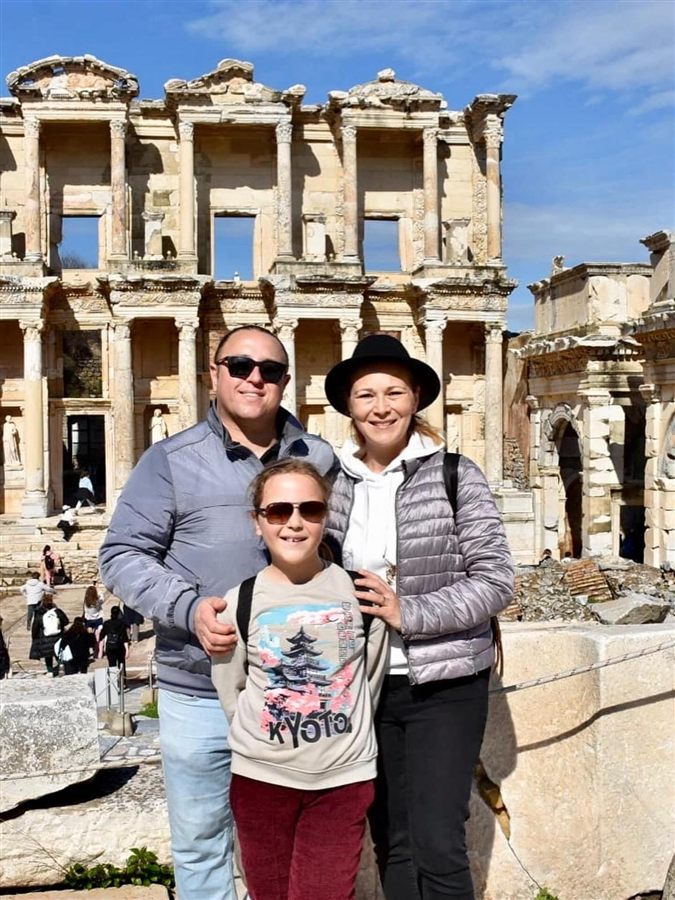
Written by Hasan Gülday · the Gülday family, Ephesus
How the Virgin Mary came to Ephesus
Virgin Mary remained in Jerusalem following the crucifixion of Jesus Christ. Life for the early Christians grew harder every day under the pressure of the local communities. Saint Stephen was stoned to death and became the first Christian martyr in the year 36 AD; his martyrdom, and the fear of a similar fate, forced the disciples and believers of Jesus out of Jerusalem.
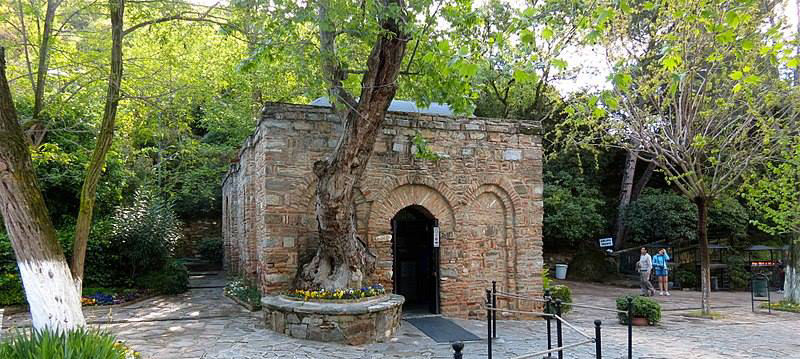
On the cross, Jesus had entrusted His mother to His beloved disciple: “Woman, here is your son… Here is your mother.” (John 19:26–27). Faithful to those words, Saint John the Evangelist took Mary under his care. She first came to Antioch to meet the other disciples, and later made her way to Ephesus with John — the city where he would lead the church, and where he is buried. The stone house on the quiet, green slopes of Bülbül Mountain became her residence: the House of Virgin Mary that pilgrims visit today, Meryem Ana Evi in Turkish, “Mother Mary’s house.”
Where is Mary’s house in Ephesus?
About seven kilometers from the ruins of ancient Ephesus, and nine from the modern town of Selçuk, a forest road climbs Bülbül Dağı — Nightingale Mountain. Near the top, in a clearing among pines and plane trees, stands the small stone house, with the sacred spring below it and the wishing wall beside the spring. The whole mountainside lies within the UNESCO World Heritage area of Ephesus, whose listing names the House of the Virgin Mary among the places of Christian pilgrimage.
The visions that led to its discovery
For centuries the house lay forgotten in the mountains — until it was found thanks to the visions of Anne Catherine Emmerich (1774–1824), a bedridden German nun who saw remarkably detailed visions of Virgin Mary’s life. People began to take her seriously when they realized how vivid and precise her descriptions were: the shape of the house, the hearth, the spring beside it, even the view of the sea from the mountain. She also bore a mark of holiness that made the world listen: the stigmata.
The German author Clemens Brentano recorded her visions and turned them into books, including “The Life of the Blessed Virgin Mary.” Anne Catherine had never left Germany. She had never seen Ephesus.
Years later, two priests living in Izmir set out to look for the house described in those pages. After two days of searching the mountains around Ephesus — and just as they were about to give up — they came across a spring exactly like the one in Emmerich’s visions, and beside it, a ruined stone house. The similarities were indisputable. The house had been found. The full story of the discovery deserves its own page — few detective stories can match it.
Is it really her house? What the evidence says
The Church has never issued a dogmatic pronouncement — and we would rather tell you honestly what is known. The walls you see date to the 6th–7th centuries; beneath them lie foundations from the 1st century AD, the very lifetime of Mary. Ancient tradition — attested by the Council of Ephesus of 431 AD, which proclaimed Mary Theotokos in a great church already dedicated to her in this city — places Mary and John in Ephesus. And the Orthodox villagers of Şirince had climbed to the ruin in pilgrimage every 15th of August, calling it Panaya Kapulu, long before any book pointed to it. Read the history of Ephesus itself and the pieces fit.
What pilgrims find there today
Today the house is a small, lovingly restored chapel, shaded by plane trees and pines, filled with candlelight and quiet. Pilgrims drink from the sacred spring that flows beneath the house, light candles for their loved ones, and leave their written prayers on the wishing wall in the lower gardens.
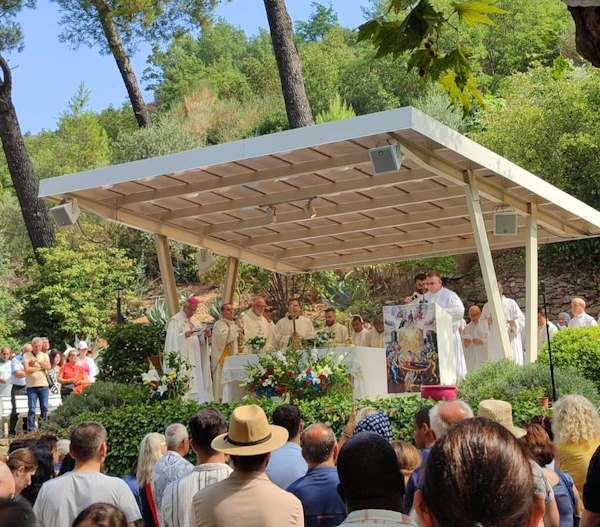
Every year on the 15th of August — the Feast of the Assumption — a special service gathers believers from around the world in front of the house. And through all the seasons, people of every faith stand side by side here: Virgin Mary is deeply loved by Christians and Muslims alike.
Sources & further reading
- Ephesus — UNESCO World Heritage List — official listing, includes the House of the Virgin Mary
- Ephesus — Ancient City, Turkey — Encyclopaedia Britannica
- Councils of Ephesus (431 AD) — Encyclopaedia Britannica
- Homily of Benedict XVI at the Shrine of Meryem Ana Evi — Vatican.va, 29 November 2006
- House of the Virgin Mary — Wikipedia
Long before its official discovery, the Orthodox villagers of Şirince called the ruin Panaya Kapulu — “the Doorway to the All-Holy” — and climbed to it in pilgrimage every 15th of August, a tradition passed down from a time beyond memory.
“My soul glorifies the Lord and my spirit rejoices in God my Savior… From now on all generations will call me blessed.”
Luke 1:46–48


“Life pulled my husband and me apart many years ago, and pride kept us apart. When word reached me that he had passed away, I sent one prayer to the wall — the farewell I never managed to say in person. The night it was placed in Mary’s garden, a weight I had carried for thirty years finally lifted. I forgave him, and I forgave myself. Rest well, my love.”
Susan · Ohio, United States
What people ask about Mary’s house
Did the Virgin Mary really live in Ephesus? ▾
Christian tradition says yes. Going back to the first centuries, it holds that Mary left Jerusalem with the Apostle John — to whom Jesus had entrusted her from the cross — and that John brought her to the region of Ephesus, where he later led the church and where the Council of 431 was held in the great church dedicated to Mary. The stone house on Bülbül Mountain, rediscovered in 1891, is venerated as her final home. The Church has never issued a dogmatic ruling, but three popes have prayed there.
Where is the Virgin Mary’s house? ▾
On Bülbül Dağı (Nightingale Mountain), about 7 km from the ancient city of Ephesus and 9 km from the town of Selçuk, in İzmir province, Turkey. In Turkish it is called Meryem Ana Evi — “Mother Mary’s House.”
Is the House of Virgin Mary real — how do we know it is hers? ▾
Nobody can prove it, but three clues point to it. The house was found in 1891 by following the detailed descriptions of the German mystic Anne Catherine Emmerich, who had never left Germany. Its exposed walls date to the 6th–7th centuries but stand on foundations from the 1st century AD; the villagers of nearby Şirince had made an annual pilgrimage to the ruin every 15 August since a time beyond memory. Read the full story of the discovery.
What is the last known home of the Virgin Mary? ▾
This house. Ancient tradition places her final years in Ephesus with Saint John, and the small stone house on the mountain above the city is venerated as the place where she lived — and, many believe, where she was taken up into heaven (the Assumption, celebrated on 15 August).
Can I send a prayer to the House of Virgin Mary without going there? ▾
Yes — that is exactly what our initiative is for. Send your prayer and we place it, free of charge, on the wishing wall in the garden of the house.
The full story of Mary’s house
A nun who saw it, a poet who wrote it down, priests who found it, popes who prayed in it — every chapter deserves its own page.
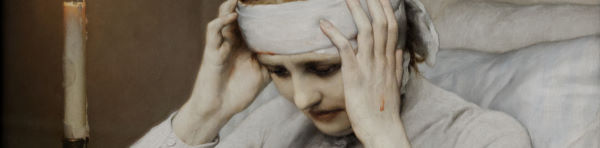
Anne Catherine Emmerich
The bedridden nun whose visions found Mary’s house — without her ever leaving Germany.
Keep reading →
The Discovery of the House
How two skeptical priests followed a book up a mountain in 1891 — and found the ruin it described.
Keep reading →
Clemens Brentano
One of Germany’s greatest poets spent five years at a sickbed, writing down the visions.
Keep reading →Continue the story
Popes at Mary’s House
Paul VI, John Paul II, Benedict XVI — a century of papal devotion to the little stone house.
Keep reading →
The Stigmata
The wounds of Christ on a nun’s body — and other saints who bore the same mysterious marks.
Keep reading →
Restoration of the House
From a roofless ruin to a living shrine that welcomes a million pilgrims every year.
Keep reading →Your prayer belongs here too
Send us your prayer or wish, and we will place it on the wishing wall in Mary’s garden — free, always.
Send my prayer nowFree · No donations asked · Any language · Placed by our family in person